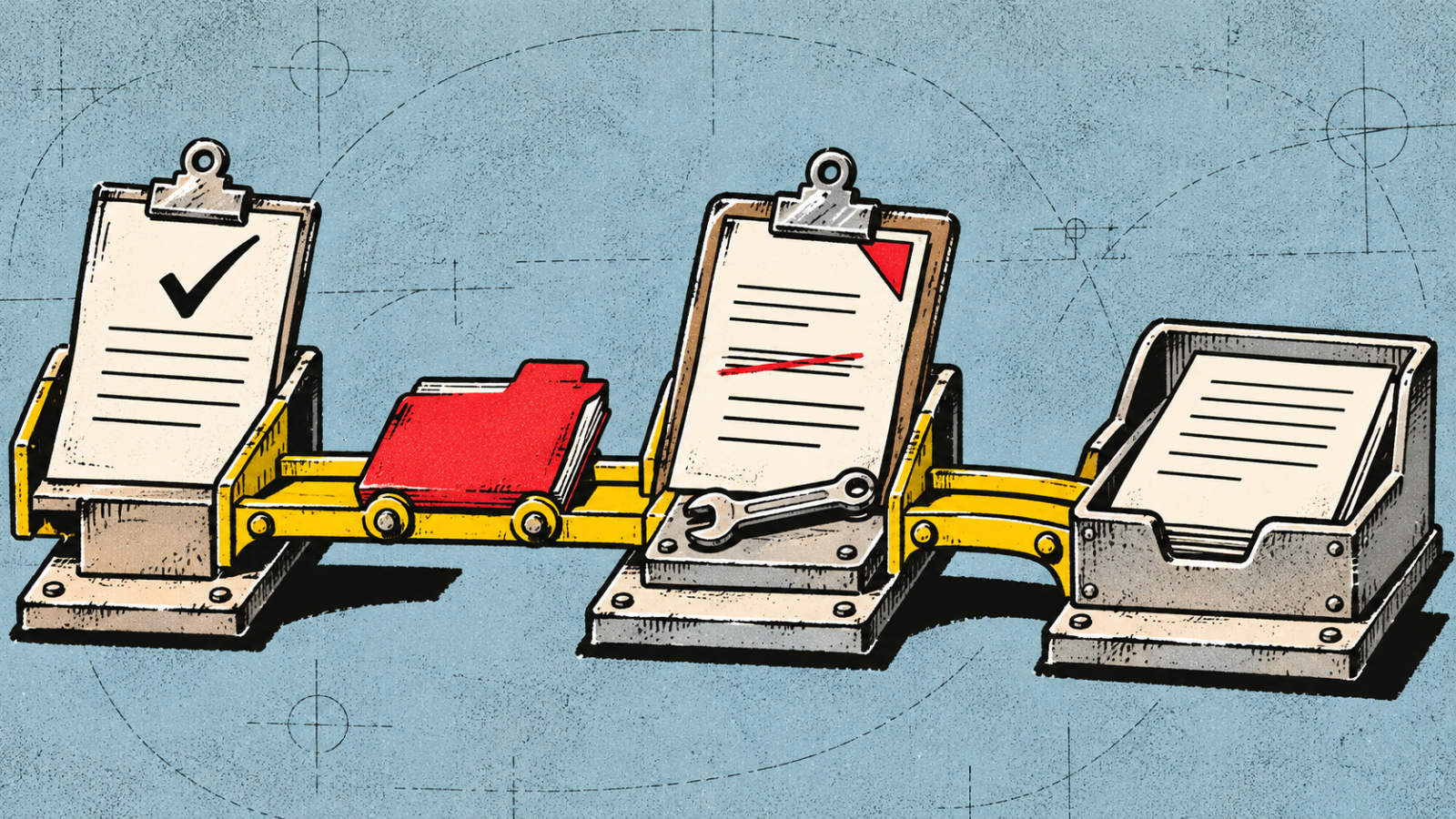
A customer accepts your quote for three site visits, then asks to postpone the last one. The service team needs to know which visits to schedule. Finance needs to know which work took place and what the customer agreed to pay for. Sending the original quote to both teams gives them the same document, but leaves those decisions open.
Before connecting sales, operations and accounting, agree what each step allows the next team to do. Keep the accepted quote, the authorization to do the work, the record of completed work and the decision to issue an invoice distinct. Some businesses combine these steps; the connection still needs to respect what each decision means.
Follow one job from sales to finance
Imagine a company that services equipment at customer sites. Its customer accepts revision 2 of a quote for three visits. For this fictional job, the company uses a separate work order and asks finance to review an invoice draft after each approved visit. Those are the example company's choices. Use the trigger and approval rules your own business agrees with finance.
Microsoft's Dynamics 365 Sales guide to quotes, orders and invoices shows one way a product separates these records and handles quote revisions. What matters for this job is what each record tells the next person.
Accepted quote
Sales records the exact revision the customer accepted and the agreed scope. That record is the basis for the work order.
Work authorization
Operations checks the scope and releases the work to the scheduler. The work order shows what can be scheduled and what is on hold.
Work completed
The engineer records the visit. The service lead checks it and approves the visit record for the handoff.
Finance review
Accounting receives a draft tied to the approved visit and the relevant terms. Finance checks the billing details and decides whether to issue it.
Use a common job reference so staff can trace the accepted revision, work order and visit records from the invoice draft. Carry the exact details each team needs. For instance, a site address helps dispatch send the engineer to the right place, while finance may need a separate billing account. Microsoft's guidance on translating between systems explains why systems that describe the same business activity can give their fields different meanings. Check those meanings before copying the values.
Keep a postponed visit out of the next draft
Suppose the engineer completes the first visit, and the customer asks to postpone the third. Sales records the agreed change against the accepted quote. The scheduler updates the work order so the second visit can proceed and the third stays on hold. The first visit remains completed, with its approval and link to the terms that apply to it. Keep the original accepted quote and record the change alongside it, so staff can see what was agreed at each point.
Under this company's chosen rules, finance reviews a draft for the first visit only. The second visit is still scheduled, and the third has no new date. Neither is included. When the customer and scheduler agree a date for the third visit, the scheduler releases the hold. That visit follows the same completion and review steps when it happens. The result is one completed visit ready for finance review, one still scheduled and one clearly on hold until a new date is agreed.
Give cancellations the same explicit treatment. Decide who can cancel work, who checks what was already done and who tells finance if there is a draft or issued invoice affected by the change. The connection can flag the affected records for review. Finance decides how to handle them under the business's rules.
Give rejected handoffs to someone who can fix them
If accounting rejects the first visit's draft because it cannot match the customer to a billing account, keep the visit marked complete. Show the handoff as rejected and tell the finance owner which match failed. In this example, finance confirms the correct account, fixes the mapping and retries the handoff. Accounting accepts exactly one draft for the first visit, with the job reference still attached. Finance still has to authorize the invoice before it is issued.
A missing reply is a different problem: the draft might already exist. Before trying again, check what accounting received. Our guide on what happens when an integration receives the same update twice goes into the checks that keep a second delivery from creating a second draft.
Agree what the supplier should demonstrate
Write a short handoff plan for one real type of job. For each step, name the record your staff trust, who can approve the next action, what the receiving team gets and who takes over when it cannot proceed. Agree how staff will see the difference between work completed, a draft accepted by accounting and an invoice authorized for issue.
Ask the supplier to demonstrate the same job in a separate test setup using invented customers and work records, with live work orders, dispatch and calendar actions, invoices, payments and customer messages disabled. Watch the accepted revision create the intended work order. Then postpone one visit, complete another, force a billing-account rejection and fix it. Check that the records show the expected work status, that finance receives one draft for the correct visit, and that the postponed work stays out of it. Have sales, operations and finance each check the step they own.
Once that behaviour is clear, use it to compare what integration quotes actually cover. We can help with connecting sales, work orders and accounting systems when the handoff and the work around it are defined.
Questions about connecting quotes and invoices
Should quote acceptance automatically send an invoice?
Use the trigger that finance and the business have agreed. In the example, acceptance authorizes preparation of the work order. An approved visit prompts a draft for finance to review.
How should a change after acceptance reach both teams?
Record the agreed change alongside the accepted revision. Update the work authorization and flag any affected billing record for finance. Keep the evidence of completed work intact.
What if accounting rejects a draft after the work is complete?
Keep the completed work record. Give the finance owner the specific rejection and the job reference, then check that accounting accepted the handoff after the issue is resolved.
What still needs a person?
Assign people to decisions that need judgment or authority. In the example, operations releases the work, the service lead checks completion, and finance reviews the draft and decides whether to issue the invoice.