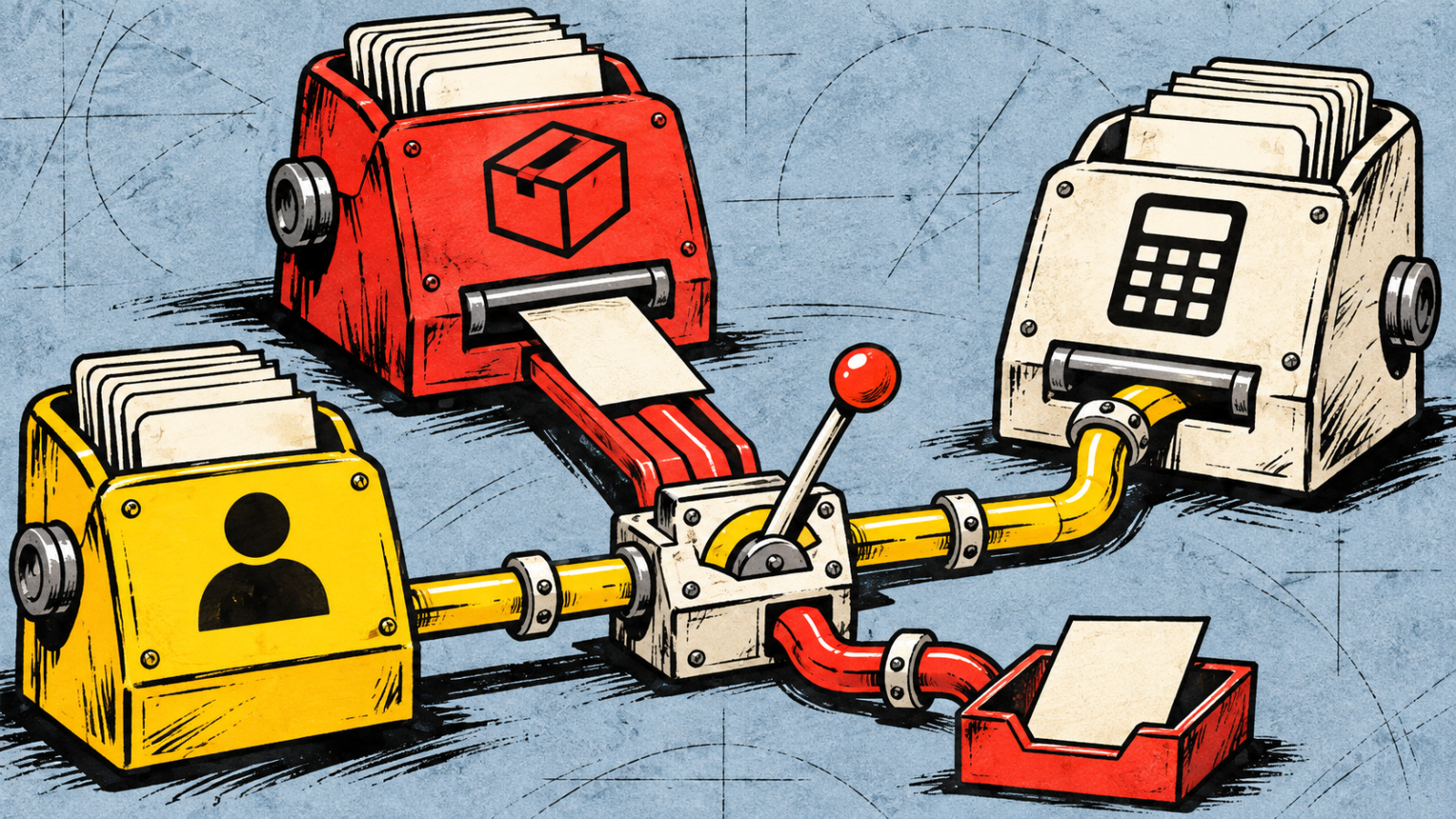
Two suppliers can quote for connecting the same CRM, order system and accounting software and still be describing quite different work. One may send new orders across. The other may also match customers, return accounting status, handle later changes and bring old records into the connection.
To compare the quotes, describe what must happen to a particular order and who checks the result. The number of applications tells you where the work happens. The rules between them tell you what needs building.
Follow one order through the connection
Imagine a fictional wholesaler. Sales keeps customer contacts in CRM, staff accept orders in an order system, and finance uses separate accounting software. The company wants an accepted order to create a draft document for finance to review.
Take order ORD-204. Its customer has CRM identifier C-81 and accounting account A-347. Someone must establish that those identifiers refer to the same customer. Matching only by company name leaves a decision unresolved when names change or two records look alike.
Then decide which system owns each fact. CRM might supply the contact name while accounting supplies the approved billing details. The order system might own the accepted quantities and agreed prices. Those are proposed rules for this example; the business needs to agree its own.
“Accepted” also needs a meaning. An order accepted by sales does not, by itself, mean that finance has approved the resulting document. Microsoft's Dynamics 365 Sales documentation illustrates the distinction through separate quote, order and invoice stages. That is one product's workflow. Your connection needs rules that fit your actual software and business.
Same three systems, different scopes
Here are three possible scopes for the fictional wholesaler. Each adds work to define, implement and check, provided the actual products support the required actions.
New orders only
After staff accept a new order, send its agreed fields and existing customer identifiers to accounting to create a draft. Finance reviews it there. Later corrections remain manual and are assigned to a named team.
Agreed changes and feedback
Also define which later order changes may cross, what happens after finance has reviewed the document, and which accounting status returns to the order system. Give unresolved changes a person to handle them.
Existing records included
Add a selected period of old orders and related customer records. Match their identifiers, resolve agreed data problems and verify the imported set before ongoing transfers take over.
The smaller scope may be enough. Its manual work must be visible in the proposal so the buyer can decide whether that arrangement is useful. The larger scopes need their extra routes and decisions described explicitly.
Write a connection map that a supplier can quote
Start with the order-to-accounting route and write down its trigger: “An order becomes accepted in the order system.” Record the order identifier and the customer identifier mapping. List the fields that move, including how quantities, discounts, currency and status are interpreted where relevant. Agree any accounting treatment with the people responsible for it.
Specify the destination action: create a draft, update an eligible draft, or send a case to finance. Name who may approve it. State the expected delay and the point at which staff should investigate an unfinished transfer. “Regularly” gives a supplier less to work with than an agreed business deadline.
Give every return route its own description. Accounting sending a document identifier back is one action. Sending a payment status back is another. Neither implies that every customer field or document can be edited in both systems.
Microsoft's guidance on translating between systems explains why different data meanings need deliberate handling, with maintenance and monitoring to consider. It describes an architectural pattern, rather than a requirement to use that pattern for every connection. For the quote, the practical point is to name the translation work instead of assuming that similar field names mean the same thing.
A useful route description for ORD-204 could say: create one draft for this accepted order using the agreed customer mapping; return the accounting identifier; show unfinished cases to the finance coordinator. The proposal must also define how repeated notifications and uncertain results are handled. That is a requirement to agree and verify, not a promise that every delivery happens exactly once.
Agree how people will check the result
For each route, record what counts as complete. A sent message alone does not tell staff whether the expected draft exists with the right customer and totals. Agree how they can compare the relevant source and destination records, spot missing or mismatched results, and find the identifiers needed to investigate.
Name the first person or team to receive an exception, the information they can see, and who can correct the source record or authorize another attempt. Include examples such as an unknown customer, a rejected field and a correction that arrives after review. Decide which cases staff handle manually.
This makes the connection map actionable: a trigger, authoritative facts, identifiers, direction, field meanings, destination action, timing, completion check and exception owner. Add the people who supply test accounts and confirm that the result is acceptable.
Put a boundary around historical data
“Include old orders” opens more questions than it answers. Choose the record types and period, decide which related customer records are needed, and assign responsibility for matching and cleaning them. State what will be checked after import.
Keep that one-time work separate from ongoing transfers. Agree where the historical set ends and live processing starts, including how changes during that handover are accounted for. Otherwise, two suppliers may allow for different amounts of preparation and checking while both write “data import” in the proposal.
Compare the assumptions and continuing work
Ask each supplier to quote against the same connection map. Have them identify what they have confirmed about product editions, permitted operations, permissions, interface limits and connector terms, and what still needs checking. An API listing or connector logo alone does not settle whether your account can perform the required action.
Where access is missing or a rule remains undecided, ask how that uncertainty will be resolved and how it affects the proposal. The UK Government's Contracting for Agile guidance discusses how incomplete information affects commercial choices in public procurement. For this comparison, the useful lesson is to make assumptions visible before treating two commitments as equivalent.
Separate the initial setup and testing from recurring software or connector subscriptions. Then identify the agreed operation and maintenance work: looking after credentials, checking unfinished transfers, adapting mappings and handling compatibility changes. Ask what is included, who does it and how later changes are agreed. A subscription line does not explain those responsibilities on its own.
Finish the comparison by walking ORD-204 through each proposal. Can you see what arrives, when it arrives, what happens if it cannot be completed, and who takes over? Any difference is a scope decision to discuss before comparing the totals.
If you want to discuss a defined connection with LINK-V, our API integration service is a relevant starting point. Bring the routes and unresolved questions; scope and ongoing care are agreed for the individual project.
Questions about integration quotes
Does an existing connector settle the integration scope?
It may cover some of the transfer work. Check the actual edition, permissions and supported operations, then agree field meanings, approvals, later changes and exception handling for your routes.
Why does historical data change the quote?
Old records may need identifier matching, cleaning, related records and verification. Specify the record types and period, who prepares them, and where the import hands over to ongoing transfers.
Who should maintain the connection after launch?
Name the people responsible for credentials, unfinished transfers, mapping changes and compatibility work in the proposal. Separate their agreed work from product subscriptions and state how support and later changes are arranged.