
Percentage-of-Revenue vs Flat-Fee Tools: What It Actually Costs at 200, 1,000, and 5,000 Subscribers
The crossover point where a
At
200 subscribers
, $2,000/month in
subscription
revenue
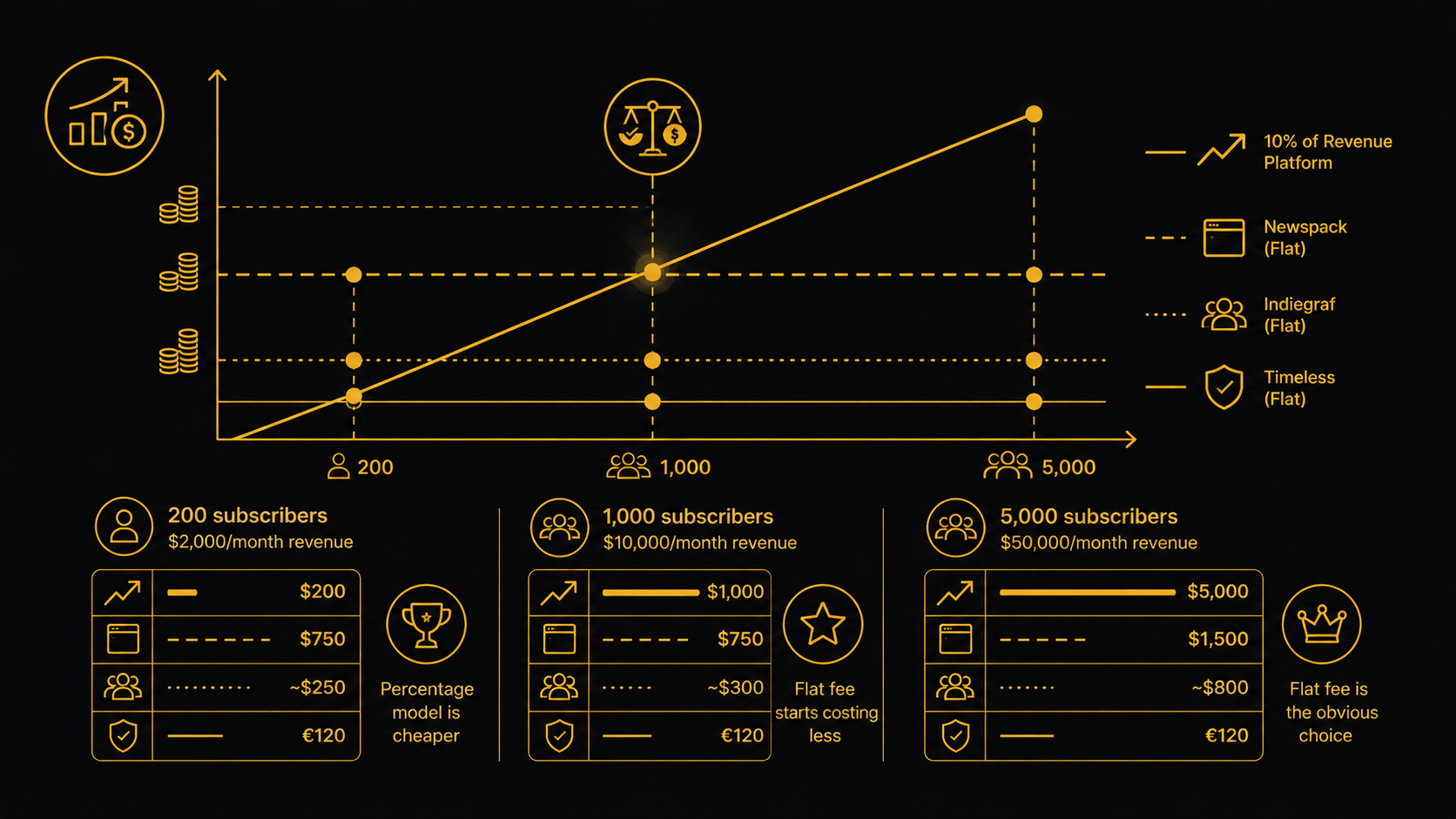
A platform charging 10% of revenue costs $200/month. Newspack's flat fee at this scale, for a newsroom under $300K in annual revenue, runs $750/month. At 200 subscribers, the percentage model is cheaper. This is the range where a percentage-of-revenue tool genuinely wins on raw cost.
At 1,000 subscribers , $10,000/month in subscription revenue
The same 10% platform now costs $1,000/month. Newspack's flat fee hasn't moved from $750/month, since $120,000 in annual revenue still sits under its $300K threshold. The percentage model has caught up to and passed the flat fee. Indiegraf's published entry pricing, in the low hundreds per month at smaller tiers, stays well under either figure at this scale, though its exact rate depends on audience size rather than revenue directly.
At 5,000 subscribers , $50,000/month in subscription revenue
The percentage model now costs $5,000/month. Even Newspack's higher tier, $1,500/month for newsrooms between $300K-$600K in annual revenue, is a third of that cost. A flat-fee model that looked expensive at 200 subscribers now looks like the obvious choice.
Where the crossover actually sits
Using a straightforward 10% cut against Newspack's published tiers, the crossover lands somewhere between 400 and 600 subscribers at a $10/month price point, the point where 10% of monthly revenue exceeds the $750/month flat fee. Below that, a percentage-of-revenue tool costs less in raw dollars. Above it, the percentage keeps growing while the flat fee doesn't move until you cross into the next revenue tier.

Started with video subscription and
After years, we
This crossover point shifts with your actual subscription price . A $20/month subscription reaches the same dollar crossover at roughly half the subscriber count. A $5/month subscription needs roughly double.
Questions we get asked directly
Is a percentage-of-revenue model always worse once you're past the crossover point?
In raw monthly cost, yes, past the crossover it
Does a flat-fee platform ever cost more than a percentage model?
Yes, below the crossover point. A
Where does Timeless fit on this curve?
Timeless charges a