
Can We Update a Website Without Taking It Offline?
Many website updates can be released without a planned outage. The right approach depends on what is changing, how the website is built, and whether live data or external services are involved.
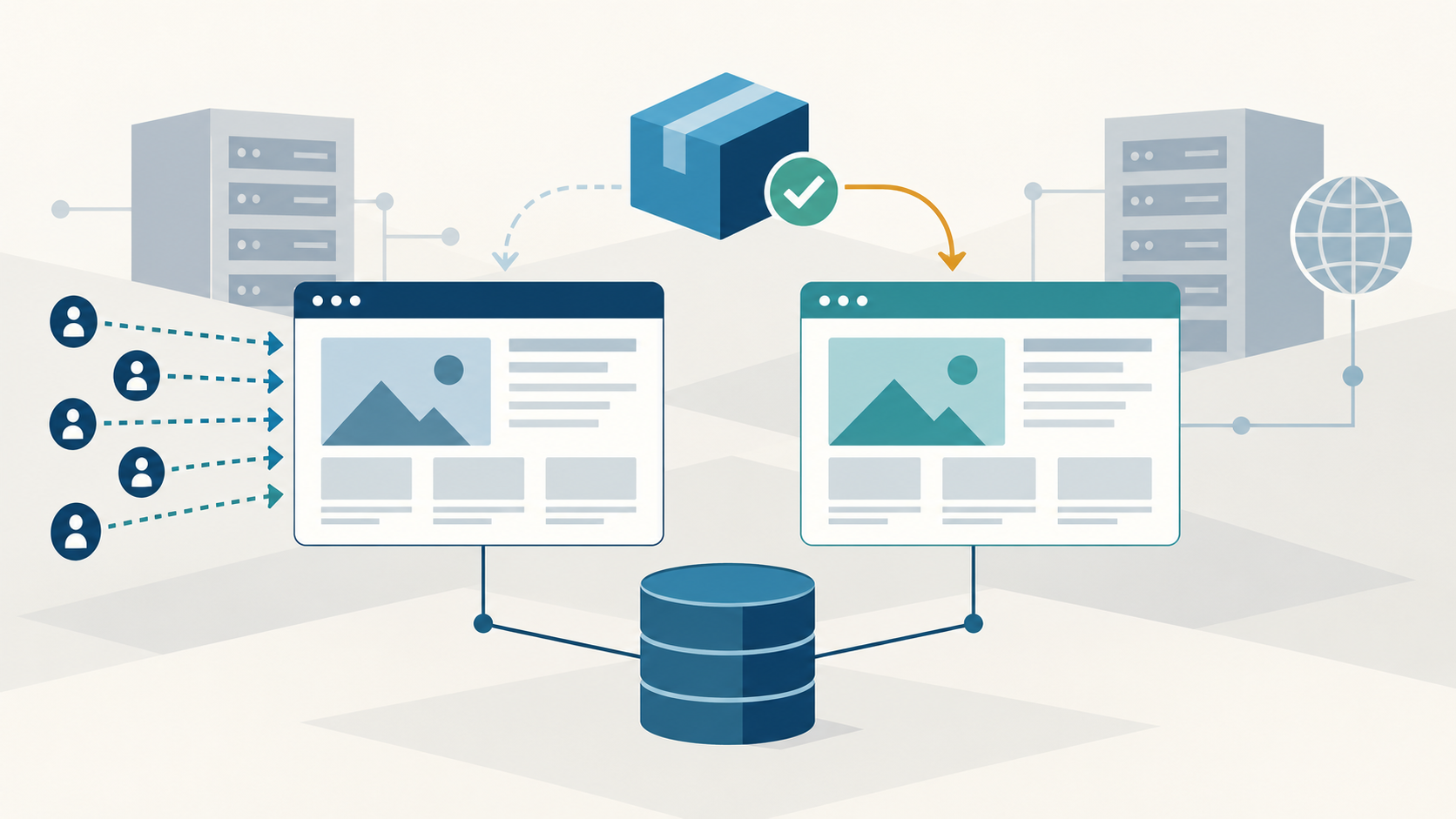
Many website updates can be released while the existing website remains available. That is often realistic for content changes, design adjustments, new pages, and carefully prepared software releases.
It is not a promise that applies to every change. An update involving live orders, member accounts, incompatible software versions, infrastructure, or an external service may need a defined maintenance window. The useful question is not simply whether the website will be online. It is what will remain available, how the change will be checked, and what happens if it does not work as expected.
Which website updates can happen while the site stays online?
Text corrections, image replacements, new articles, new pages, and isolated visual changes can often be prepared and released without taking the whole website offline. Small software changes may also be released this way when the website and its release process support it.
The type of update alone does not settle the question. A normal content edit can affect menus, search, cached pages, or generated files on one website while changing only a single page on another. A familiar task should still be checked in the context of the system carrying it.
“Online” also needs a practical meaning. A homepage returning successfully does not prove that enquiries, payments, sign-ins, searches, or administrative work still function. The parts of the website that matter to the business need their own checks.
What does a staging website protect?
A staging website is a separate place where a change can be prepared and reviewed before it reaches visitors. It can prevent incomplete layouts, unfinished text, and obvious functional faults from appearing on the public website during the work.
Staging reduces uncertainty, but it does not remove it. The staged copy may have different data, traffic, configuration, credentials, connected services, or server resources. A successful staging test is useful evidence, not a guarantee that production will behave identically.
The release plan still needs to identify what must be checked after the change reaches the public website.
How can a new version replace the old one without a blank page?
One method is to prepare the new version separately while the existing version continues serving visitors. Traffic is moved only after the prepared version has been tested. If a serious problem appears, traffic may be returned to the earlier version.
This is commonly called a blue-green deployment. AWS describes the method as shifting traffic between two environments running different versions of an application. The aim is near-zero downtime and a quicker route back to the earlier environment.
Blue-green deployment is not the only way to release an update. Some systems replace files atomically, update one server at a time, direct only part of the traffic to a new version, or enable a completed feature after its supporting work is ready. The suitable method depends on the website, its hosting, its data, and the consequences of a failed change.
Why are database changes different?
A database may contain current orders, accounts, bookings, form submissions, stock, memberships, or published content. During a release, the old and new versions of the website may both need to work with that data.
If a database structure changes in a way that only one software version understands, returning to the earlier version may no longer be simple. Long-running changes can also compete with normal website activity. Some releases therefore separate database preparation from the application update, keep old and new structures compatible for a period, or move data in controlled batches.
GitLab’s public database migration guidance shows how detailed this planning can become. It distinguishes regular, post-deployment, and background migrations, and requires attention to timing, reversibility, transactions, and lock contention. Those exact methods will not suit every website, but the underlying point is broadly useful: live data changes deserve their own release and recovery plan.
Is a backup the same as a rollback?
No. A backup is a retained copy of data or files that can be restored. A rollback is a prepared way to return from an unsuccessful release to a known working state.
Restoring a backup may take time and may replace valid orders, enquiries, edits, or account changes made after that backup was created. Reverting website code may be quick, but it may not reverse a database change or an action completed by an external payment, booking, or email service.
A responsible plan identifies what can be reversed, what must be repaired forward, and how data created during the change will be treated. AWS’s guidance for unsuccessful changes recommends preparing recovery steps before deployment and using monitoring to decide whether the change succeeded.
Why might someone still see the old page after an update?
A website can remain available throughout an update while different visitors briefly receive different versions of a page or file. Browsers, content delivery networks, server caches, and generated pages may retain earlier content until it expires, is revalidated, or is deliberately cleared.
That is different from an outage. It still matters when the update changes prices, terms, campaign details, availability, or another time-sensitive item.
Cache clearing also needs proportion. Cloudflare recommends targeted purging where possible because clearing an entire cache makes subsequent requests return to the original server until cached content is rebuilt. A release plan should identify which pages and files changed instead of treating every cache as one disposable block.
When is a maintenance window the responsible choice?
A maintenance window can be appropriate when keeping the website fully active would create a greater risk than a short, communicated interruption. This may apply when:
- live data cannot safely change during the update;
- the old and new versions cannot operate against the same data structure;
- infrastructure or network routing must be changed in one controlled step;
- an external provider requires an interruption or has no parallel test route;
- the current website has not been understood well enough to support a safe live change;
- recovery would be clearer and faster with activity paused for a defined period.
The window should have a reason, scope, expected duration, recovery decision, and communication plan. “The site will be down for maintenance” is not enough for a business that depends on enquiries, orders, bookings, or member access.
What should we ask before approving the update?
- Which pages and functions will change?
- What will visitors and staff still be able to do during the work?
- Will the change be prepared somewhere separate from the public website?
- How will enquiries, payments, bookings, account changes, and other live data be protected?
- Which checks will confirm that the release succeeded?
- What is the recovery plan if one of those checks fails?
- Can the software be reverted without reversing valid new data?
- Do any hosting, payment, email, identity, booking, or other external services affect the timing?
- Who decides whether to continue, repair, or roll back?
- How and when will affected users be informed?
The answers do not need to describe every technical command. They should make the business effect clear.
How does LINK-V approach website updates?
When we assess or maintain a website, we review the website, hosting, CMS, database, integrations, backups, access, and operational risks before deciding how work should be released. The correct method depends on what is changing and on the system already in place.
Our aim is to keep normal updates calm and proportionate while being direct when a change needs a controlled interruption. If your website supports daily sales, enquiries, bookings, memberships, or published work, we can assess its maintenance setup and ongoing care.