
SaaS vs. Custom Software - not an easy decision
Although most businesses use ready-made SaaS, custom built software is often proper and can be a cost-effective path.
This article will show you when and how to evaluate, if your company is better fit for typical Software-as-a-Service or Custom tailored software.
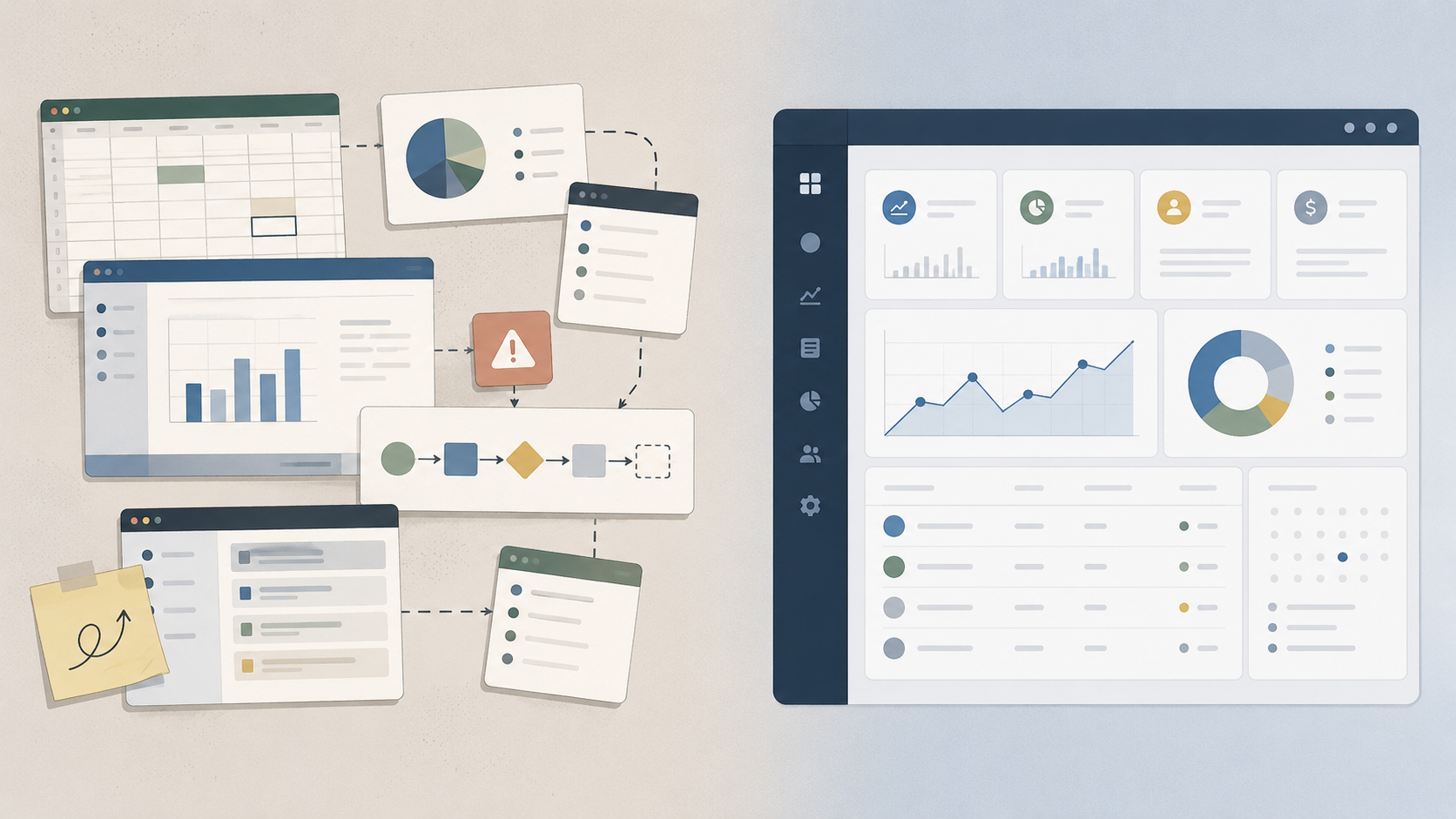
Explaining The Terms
SaaS or Software-as-a-Service means ready-made software that you either register your account and start using, or the software’s sales person will onboard your company, set everything up, and then you start.
Custom software is a solution made just for your use case, for your needs and is strictly licensed only to you (unless other specific agreement is made).
General Advantages And Disadvantages
SaaS is typically simpler and faster from decision to start being useful in both cases of starting a fresh company and migrating a long-running corporation. It has manuals and tutorials, people who work simply to understand the product. Everybody in your company has materials on how to use the program, what it can and cannot do.
Biggest disadvantage of SaaS is typically a lock-in on a feature set and processes of how they and other clients do it.
Others are data privacy, because data usually lives outside of your company and maybe even country; and reliance on operating company’s existence and “good behavior”.
Custom built software does exactly what you need, it enhances your operations. It is available to you in a location that you choose or a law requires. It bears your design identity. You typically own an exclusive license. Because you use your own methods that are visible only to you, your inner operations are hidden to any competitor. All those combined, you are getting a competitive advantage.
In the case of custom software, it’s on you to define all the processes on paper and meetings, to state what level of support and documentation you require.
Notice that there is no mention of pricing in this block. That’s because it is much more nuanced than typical discussions suggest. We will dedicate it a full block of this article.
How To Think About The Decision
The decision comes down to two main questions.
1. Do you know what your operation looks like or should look like?
It is probably a more difficult question than it sounds. If you are starting your first business, you don’t know that. If you are running a business for a couple years or spinning up new companies, you may have an idea, but you are probably operating differently.
At this point, your company is using at least one way of operation.
If that method is spreadsheets or Notion, you are closer to custom solution already. Most often, people set up sheets in a way they actually need to make the work done properly. Because you will certainly outgrow spreadsheets, you will be forced to decide sooner or later and the decision may need to be custom software.
Second option is that you are using a common SaaS solution - a CRM or task manager. If everything works to your satisfaction, employees and colleagues get their work done without blockades in their way. Stay with exactly those services (if there are no other reasons - communication with the provider, instability, growing downtime).
On the opposite, if you are experiencing blockage of any kind, delays, technical issues, it is better to start writing down what you need - more than that one issue, but what’s working and what doesn’t for you specifically. It is possible that you may find another SaaS that will fit your company much better, but with that, have a few meetings with custom software companies, like LINK-V, about possibilities.
In a situation that each department runs on something different, that each requires something of their own, custom software is a good choice, because it can be made that way - to support every department individually while keeping unified data for leadership.
2. What is the shape of your business and company?
You have to think about headcounts, how many departments, what they all need in specifics, what kind of products or services you offer and how many, how you expect to grow.
A stable company with a well-defined product or service and predictable growth is a good candidate for either path - the decision then comes down to the other factors in this article.
But if your company or product is dynamic - pivoting, expanding into new services, restructuring how you operate - custom software tends to hold up better. SaaS products are built around a fixed set of assumptions. When your business moves, those assumptions stop fitting, and you either work around them or switch tools. A custom system changes when you need it to, because there is no underlying product it has to conform to.
On Costs
The standard view is: SaaS is smaller monthly payments, custom is a large invoice up front plus ongoing fees. That is not necessarily true.
If you fully commit to SaaS, it can start small, but quickly grow in several different ways.
- Typically, services are being paid by seats - more employees, more fees directly.
- Services often specialize, therefore you need multiple different services. Each with their own rules.
- Once you have multiple services, you think about how to get meaningful view of all data together and may end up paying for custom development of a bridging software.
- If you need any specialized update, those are usually large sums.
- There is a cost to any hiccup or delay if the software doesn’t operate exactly as your company, product or service requires.
From the side of custom software, there is a variety of choices in financing. Some choices software companies offer you may find compelling:
- Only monthly licensing fee - you pay monthly for fully custom software, support and servers. This price tag includes development and service. It is a very popular model with our clients.
- Payments over a period of time, years even. There may or may not be initial invoice for part of the development and the developer company makes you guarantees of their accessibility for the time being.
- Of course, few milestone invoices during development, traditional model, still offers almost every custom software company.
Usually uncomfortable thought is: what do we have if something happens? What if the company that provides or made you the piece of software, goes under, gets hacked, leaks your data? What is the cost? Is it full migration? Data loss? Legal case?
SaaS providers have often ready-made emergency plans, some are public and some internal. In custom software case, development companies have defaults and options they offer, but it is whatever you need and negotiate.
Changing A Decision
It is possible and achievable, also very often worth the migration cost.
You may be perfectly fine with a solution for years until you grow out of it - your staff rotates to different personalities, your offering keeps subtly changing. Once you start seeing signs of this, it is advisable to start looking for other options. Otherwise you might be locked in a bad solution with costs of every job growing, in a solution meant for 10-person companies while you grew into 100 with several departments.
As discussed in previous block, making a decision later is a reasonable move - once you work and learn what you need. But it is probably not as simple and cheap. It may also not be as complicated as it may sound.
We will be discussing a migration in both ways. There are only small differences that we will hint in the following paragraphs.
Technically, a migration requires a lot of safeguards, technical assurances and tests. Although it’s technical work, we recommend to assign a reliable person on your own payroll to oversee and verify migration, safety and basic data security.
The main step is onboarding your employees. You are changing environment in which they work, changing rules.
Depending on size of your company, it may be as simple as installing a new app onto your employees’ computers and phones while having a meeting with everybody to present the new system.
What We Offer
LINK-V offers a variety of software - custom development, some SaaS under Grace name, perpetual licenses of software. CRM, CMS, apps, email server and more.
We specialize in high quality solutions. We provide you with documentation, support, onboarding, fast software with CEO in the field since 2008.
Conclusion
Easy-to-pickup SaaS options make company processes seem like universal rules, but each company has a unique “chaos” made by unique combinations of people and need different solutions.
Pricing is not as it used to be - SaaS is are more expensive and developer studios offer competitive pricing models.
We recommend to explore. Have a call or a meeting with us and other developer studios to find out options or to confirm your previous decision.